


This week Microsoft announced the end of Azure Communication Services as a standalone product, while Twilio shipped a way for your backend to sit in a video room as a participant. WhatsApp also opened its calls to guests who join from a browser.
⭐ Tsahi’s Pick
Azure Communication Services retirement and breaking changes guide (Microsoft Learn)
Microsoft will retire Azure Communication Services as a standalone offering on September 30, 2028. The calling SDK survives only for Teams scenarios, while Rooms, Chat and the UI libraries are gone with no Microsoft replacement for the UI, and from October 23 new customers can’t even get phone numbers. Anyone who built a white-label video app on ACS is being pointed at Teams or at partners like Infobip and Telesign (both make little sense if the thing you need is video).
📰 This Week in WebRTC
Azure Communication Services Retirement: Planning Your Video API Migration (WebRTC.ventures) - migration options and a checklist for apps built on Azure Communication Services
Why Android’s Hardware VP9 Encoder Can’t Do Spatial SVC (Stream) - to be frank, hardware encoders were never built to support video calling scenarios
Twilio Video Media SDK Powers Smarter Customer Engagement (Twilio) - public beta of a server-side SDK for your AI agents and algorithms
The Black Hole Node: how one full disk broke recordings in an entire WebRTC cluster (OpenVidu) - recording has its challenges in storage resource management
WebRTC Benchmarking: Why a Clean Call Recovery Test Can Be Wrong (WebRTC.ventures) - benchmarking Google Meet and Zoom Web recovery after a network drop. I’d give the recovery period at least a full minute, also assume Zoom Web is not on par with the Zoom app
Now you can invite anyone to a WhatsApp call: no account needed, no cost, no time limit (WhatsApp) - guest calling: anyone joins a WhatsApp call from a browser. 10 years after it was useful (now that almost everyone has WhatsApp)
📣 Sponsor
WebRTC Live is a monthly webinar series featuring real-time industry guests, hosted by WebRTC.ventures.
Join us for the November 4 episode, “WebRTC, MoQ, or Both? A QUIC Study” with guest Lorenzo Miniero.

💭 This Week’s Thought
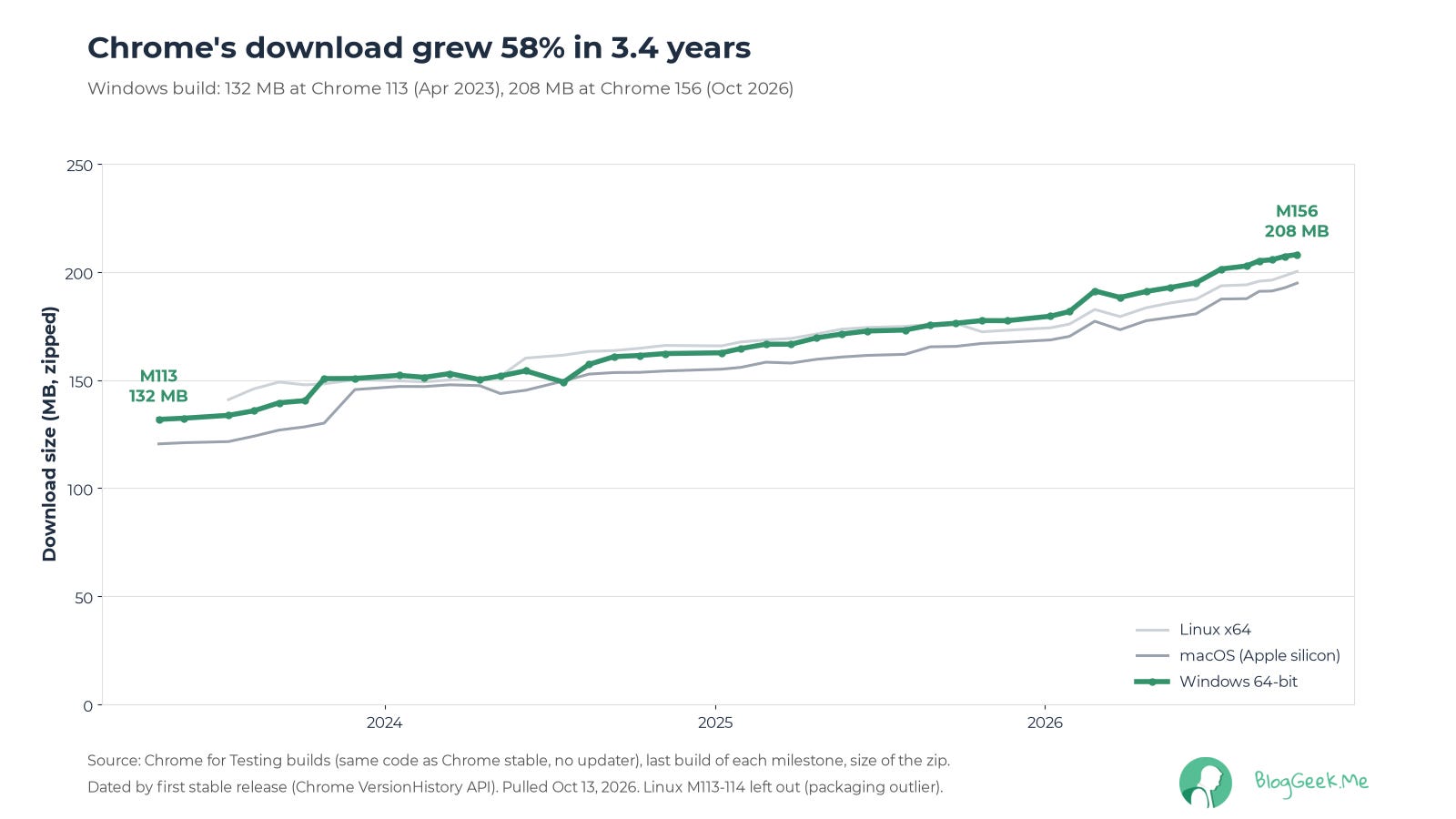
The basic Chrome application is a beast of an app these days. Within a span of 3+ years, it grew by over 50% to more than 200 MB in size. We’ve seen the decision of Google to place their shiny new neural echo canceller as an automatically downloaded binary - likely so it won’t increase that number further. We also just found out and published an analysis to our WebRTC Insights subscribers about an even newer AI-driven voice isolation algorithm that gets downloaded dynamically.
Is this how things are going to take place from now on? Features and capabilities that are below a certain threshold of users who use them (5%? 10%?) will be downloaded on demand instead of part of the main binary. Or is it just for the things Google wants to keep closer to their chest as competitive advantages?
📢 Releases
October Updates v2.1: Redesigned Analysis, Security Hardening & Data Export - a rebuilt Analysis page, security hardening and more